Clinton Osondu

Stitch
The reason that photo is important to me is that it represents care, support, and love in a way that’s really simple but powerful. The teddy itself was a gift, a surprise. My friend gave it to me. They said, “Even if I’m not here, I’m still here. This is a reminder of me.”
Sometimes you can feel lonely, or like people are too busy or far away. And then something like this little teddy reminds you – no, actually, they are there for you. It represents love, connection, and safety. It also reminds me that small things can have big meanings. You might think, “Oh, it’s just a toy,” but it’s not. It carries all those feelings.
Support doesn’t have to be huge or complicated. Sometimes it can be a tiny gesture, like giving someone something to hold on to, that makes them feel cared for. For young people, especially, it’s important to know that you can talk to someone. Keeping things bottled up inside just makes it worse.

Wellbeing through challenge and Achievement
This is a mountain in Wales that I climbed.
For me, it’s about confidence and well-being through challenge. Climbing a mountain sets me a goal. Instead of ruminating about university or all the other things in my head, I could focus just on climbing, achieving that aim, and then celebrating with the group afterwards. That sense of connection also boosted my confidence. Some of the group had never climbed a mountain before, so I could encourage them when they wanted to give up. I like helping others build confidence too, not just my own.
There was so much nature – sheep, grass, waterfalls, and all these beautiful colours. We’d describe what we saw to each other, what we liked about the scenery, and even started planning our next challenge – like climbing the highest mountain in Scotland next year.
I really recommend hiking – it’s a good challenge, and a metaphor for life. Sometimes the straight path doesn’t work, but you can find another way around and keep going.
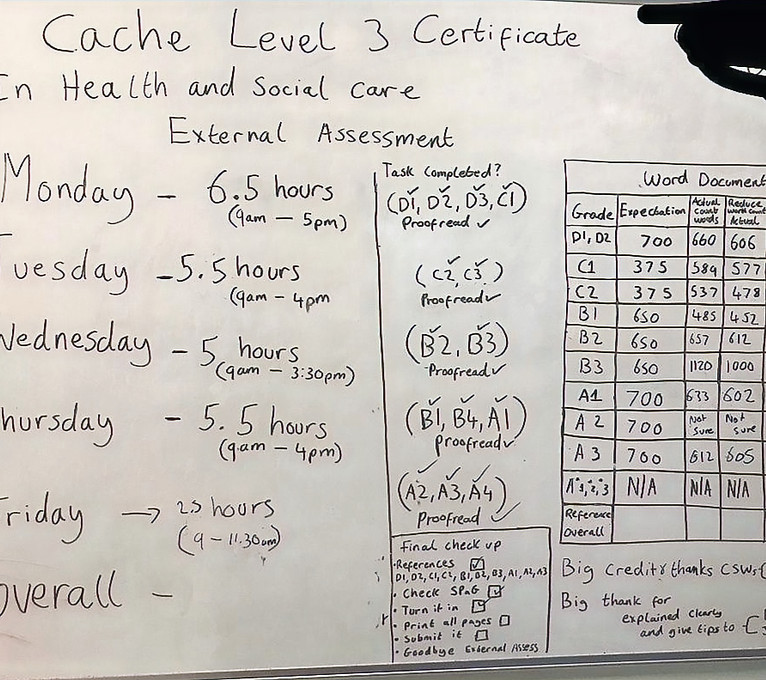
The Whiteboard (Health and Social Care Exams)
This photo shows a whiteboard next to my computer with lots of writing, numbers, calculations, and books. That whiteboard represents stress.
I’m studying Health and Social Care, Level 3 – a certificate and extended diploma. We’re not allowed to do the exams at home – they have to be done in person, on the day. There are five exams, each five hours long – 25 hours total. We can’t ask staff questions or clarify anything; you just have to answer and hand it in.
Each question has a strict word limit – if it says 300 words, you must follow it. Sometimes when I sign my answers, the interpreter translates them into English, and they might go over the limit – like 340 words instead of 300 – and then we need to cut it down again.
After each exam day, I can’t just go home and switch off; I have to think about the next day’s paper and prepare again. It’s exhausting. I can’t go out with family or friends that whole week – I stay in to study. I’m not allowed to meet the interpreter before the exam or at home – it must be in person. We get a four-hour limit with the interpreter: one hour of interpreting and three for typing, checking grammar, and signing off.